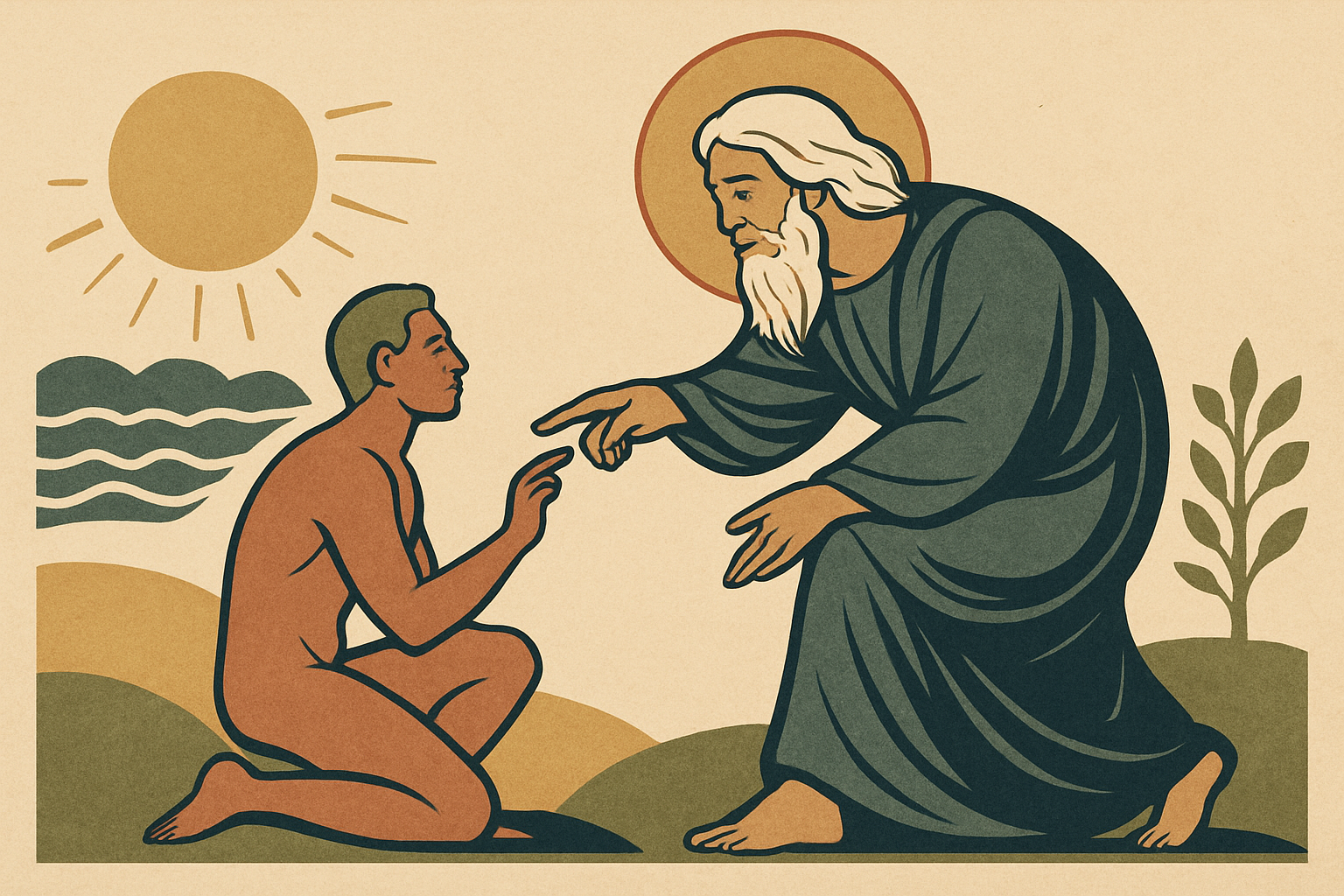
Introduction: The Torah begins with Parashat Bereisheet, the very first portion of the Book of Genesis. Since this is the opening of the Torah, there is no previous parasha to summarize. Instead, we are introduced to the very beginning of everything: the creation of the world, humanity, and the earliest stories of human experience.
The Parasha in Simple Words: In the beginning, God created the heavens and the earth. The earth was empty and dark, and God's spirit hovered over the water. God said, "Let there be light," and there was light. God separated the light from the darkness, calling the light "day" and the darkness "night." This was the first day. On the second day, God made a space to separate the waters above from the waters below, calling this space "sky." On the third day, God gathered the waters below the sky so dry land appeared, calling the dry land "earth" and the gathered waters "seas." God made plants, trees, and all kinds of vegetation grow from the earth. On the fourth day, God made the sun, moon, and stars to give light to the earth and to mark days, years, and seasons. On the fifth day, God created fish and sea creatures to fill the waters, and birds to fly in the sky, blessing them to multiply. On the sixth day, God made animals to live on the land: livestock, wild animals, and creeping things. Then God said, "Let us make humans in our image, to rule over the fish, birds, animals, and all the earth." God created humans, male and female, in His image, and blessed them to be fruitful, multiply, fill the earth, and rule over all living things. God gave them every seed-bearing plant and fruit tree for food, and gave green plants to the animals for food. God saw everything He made, and it was very good. On the seventh day, God finished His work and rested, blessing and making the seventh day holy.
After this, the Torah describes how God made man from the dust of the earth and breathed life into him. God planted a garden in Eden, placing the man there to work and guard it. In the garden, God made every beautiful and good tree grow, including the Tree of Life and the Tree of Knowledge of Good and Bad. God told the man he could eat from any tree except the Tree of Knowledge; if he ate from it, he would die. God saw the man was alone and decided to make a helper for him. God brought all the animals and birds to the man to name, but none were a suitable partner. So God made the man fall asleep, took one of his ribs, and made it into a woman. The man said, "This is bone of my bones and flesh of my flesh; she will be called woman because she was taken from man." The Torah notes that this is why a man leaves his parents and joins with his wife, becoming one flesh. At this point, the man and woman were naked and not embarrassed.
The serpent, the cleverest of the animals, spoke to the woman and asked if God really said not to eat from any tree. The woman replied that they could eat from all the trees except the one in the middle of the garden, and that if they touched or ate from it, they would die. The serpent said they would not die, but would become like God, knowing good and bad. The woman saw the tree was good for food and beautiful, and desirable for wisdom, so she ate and gave some to her husband, who also ate. Their eyes were opened, and they realized they were naked, so they made themselves clothes from fig leaves. When they heard God in the garden, they hid. God called to the man, who said he was afraid because he was naked. God asked if he had eaten from the forbidden tree. The man blamed the woman, and the woman blamed the serpent. God cursed the serpent to crawl on its belly and be hated by humans. God told the woman she would have pain in childbirth and desire her husband, who would rule over her. God told the man the ground would be cursed because of him, and he would have to work hard for food until he died and returned to dust. God made clothes of skin for the man and woman and sent them out of the garden to work the earth. God placed angels and a flaming sword at the entrance to guard the way to the Tree of Life.
The man, Adam, and his wife, Eve, had two sons: Cain and Abel. Abel became a shepherd, and Cain a farmer. Cain brought an offering from his crops, and Abel brought the best of his sheep. God accepted Abel's offering but not Cain's. Cain became very upset, and God told him that if he did good, he would be accepted, but if not, sin was waiting for him, and he must rule over it. Cain spoke to Abel and then killed him in the field. God asked Cain where Abel was, and Cain replied, "Am I my brother's keeper?" God said Abel's blood cried out from the ground and cursed Cain to wander the earth. Cain complained the punishment was too great, so God put a mark on him to protect him from being killed. Cain left and lived in the land of Nod, east of Eden. Cain had descendants, including Enoch, Irad, Mehujael, Methushael, and Lamech. Lamech had two wives and children who became the first tent-dwellers, musicians, and metalworkers. Lamech said he killed a man and spoke about being avenged more than Cain.
Adam and Eve had another son, Seth, and people began to call on God's name. The Torah lists the descendants from Adam to Noah: Adam, Seth, Enosh, Kenan, Mahalalel, Jared, Enoch (who "walked with God" and was taken by God), Methuselah, Lamech, and Noah. People lived very long lives. When people began to multiply, the "sons of God" saw the daughters of men and took them as wives. God said His spirit would not always judge humans, and their days would be 120 years. There were giants on the earth. God saw that people were very wicked, and their thoughts were evil all the time. God regretted making humans and decided to destroy them along with animals and birds. But Noah found favor in God's eyes.
Idea from the Parasha: One of the most powerful ideas in this parasha is the concept of free will and responsibility. When Adam and Eve eat from the Tree of Knowledge, they are confronted by God and each tries to shift the blame. Yet, the Torah shows that every person is responsible for their own choices. Later, when Cain is angry, God tells him that "sin crouches at the door, but you can rule over it." This teaches that even when faced with temptation or difficult emotions, humans have the ability—and the duty—to choose their actions. The Torah’s opening stories are not just about the creation of the world, but about the creation of human moral responsibility. We are not just shaped by our circumstances; we are called to shape ourselves through our choices.
Created by Rabbi Ari (AI)