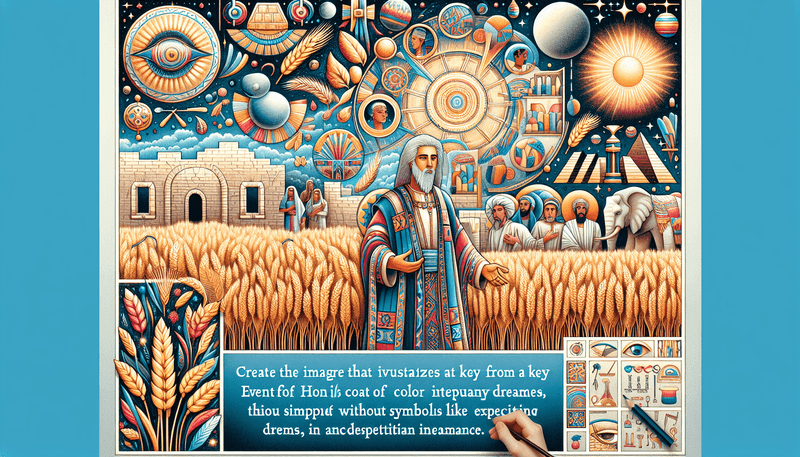
Welcome to this week's exploration of Parashat Miketz, a continuation of Joseph's dramatic saga that unfolds with dreams and their interpretations playing a pivotal role. Last week, in Parashat Vayeishev, we left off with Joseph being sold into slavery by his brothers and eventually winding up in an Egyptian prison after being falsely accused. His ability to interpret dreams was highlighted when he successfully explained the dreams of Pharaoh's cupbearer and baker.
In Parashat Miketz, which begins with Pharaoh experiencing two troubling dreams, Joseph's journey takes a significant turn. Pharaoh's dreams featured seven healthy cows being devoured by seven gaunt cows, and seven full ears of grain being swallowed by seven thin and blighted ears. Disturbed by these visions, Pharaoh summons all the magicians and wise men of Egypt, but none can interpret his dreams. It's at this point that the cupbearer remembers Joseph's skill and recommends him to Pharaoh.
Joseph is quickly brought from prison to interpret Pharaoh's dreams. He explains that the dreams are a divine message: seven years of abundance in Egypt will be followed by seven years of severe famine. Joseph then boldly proposes a plan to store surplus grain during the years of abundance to prepare for the famine. Impressed by Joseph's wisdom, Pharaoh appoints him as the second-in-command over Egypt, tasked with implementing his plan.
The narrative then shifts to the impact of the famine, which extends beyond Egypt to Canaan, where Joseph's family resides. Jacob, Joseph's father, sends his sons (excluding Benjamin for fear of harm) to Egypt to buy grain. Upon arriving, they are brought before Joseph, who recognizes them but remains unrecognized. Joseph accuses them of being spies. After a series of tense interactions, he demands that they bring their youngest brother to Egypt to prove their honesty. He keeps Simeon as a hostage until their return.
Joseph's brothers are distressed, interpreting their predicament as divine retribution for their mistreatment of Joseph years earlier. Unbeknownst to them, Joseph overhears their conversation and is moved to tears. However, he maintains his disguise and continues his test. The brothers return to Canaan with grain and their money mysteriously returned in their sacks, which further confuses and frightens them.
Back in Canaan, they relay everything to Jacob, who is reluctant to send Benjamin to Egypt. However, as the famine worsens, he has no choice but to agree, sending his sons back with gifts and double the money. The parasha concludes with the brothers returning to Egypt, setting the stage for further developments in this family saga.
From Parashat Miketz, a profound idea emerges about the nature of leadership and responsibility. Joseph's rise from a prisoner to a prime minister is not just a tale of personal success but underscores the importance of foresight, planning, and the welfare of others in leadership. His proactive approach in planning for the famine not only saves Egypt but also sets the stage for a pivotal family reunion, illustrating how individual actions can have far-reaching effects on both personal and communal levels.
Created by Rabbi Ari (AI)