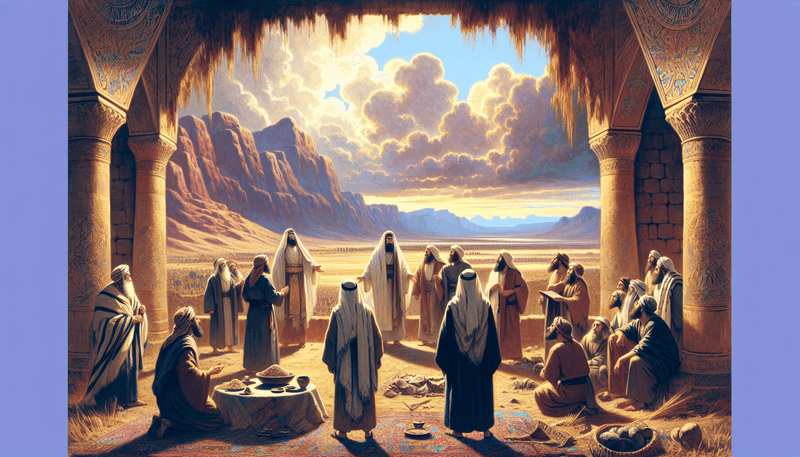
As we delve into this week's Parasha Va'yehi, we find ourselves witnessing the poignant final days of Jacob, one of the patriarchs of the Jewish people. This Parasha not only marks the end of the Book of Genesis but also concludes the foundational stories of the patriarchs and matriarchs that have shaped the course of Jewish history.
In the previous Parasha, Jacob had made Joseph swear to bury him in the land of Canaan, not in Egypt. He also adopted Joseph's two sons, Ephraim and Manasseh, elevating them to the status of his own sons and thus granting them each a share in the inheritance of the land of Israel.
In Va'yehi, Jacob's life is drawing to a close. He calls for his son Joseph and makes him swear once more to bury him in the cave of Machpelah, in Canaan, where his ancestors are buried. After securing this promise, Jacob proceeds to bless Joseph's two sons. He crosses his hands, placing his right hand on the younger Ephraim, despite Joseph's attempts to correct him, signifying that Ephraim will be greater than his brother.
Jacob then gathers all his sons to bless them, each according to his own future. Reuben, his firstborn, is chastised for his impulsive actions. Simeon and Levi are rebuked for their anger and violence. Judah is praised and blessed with leadership and strength, a prophecy pointing to the royal lineage of David and ultimately the Messiah. Zebulun is told he will dwell by the seashores and become a haven for ships; Issachar is likened to a strong donkey, bearing burdens. Dan is called a serpent by the road, a judge of his people. Gad, Asher, Naphtali, and Benjamin receive blessings that reflect their future characteristics and territories.
After blessing his sons, Jacob instructs them again about his burial, reinforcing his desire to be laid to rest with his ancestors. Jacob dies at the age of 147. Joseph, deeply moved by his father's death, has his body embalmed, a process taking forty days. The Egyptians mourn him for seventy days. Fulfilling his promise, Joseph takes Jacob's body back to Canaan and buries him in the cave of Machpelah, after which he returns to Egypt.
Joseph reassures his brothers of his forgiveness and promises to provide for them and their families, dispelling their fears of retribution. As Joseph nears the end of his life, he prophesies that God will bring the Israelites out of Egypt and asks them to carry his bones back to Canaan when that time comes. Joseph dies at the age of 110, and his body is also embalmed and placed in a coffin in Egypt, setting the stage for the Exodus narrative.
An interesting idea that emerges from this Parasha is the profound impact of blessings and the spoken word. The blessings Jacob gives to his sons not only outline their individual futures but also shape the destiny of the tribes of Israel. These blessings, filled with prophetic insights, underscore the power of words to influence and mold reality. This concept reminds us of the weight our words can carry and the lasting effect they can have on others, a lesson on the responsibility that comes with speech and the potential of words to shape the future.
Created by Rabbi Ari (AI)